Communications Audit Services
See your communications from the outside.
An independent review of your website, messaging, and digital presence—with clear priorities for what should happen next.

Clear thinking.
Plain language.
Occasional goats.
What are people actually encountering?
A communications audit reveals the gap between what you mean to communicate and what customers, clients, members, donors, and neighbors experience.
website audit
A close look at what your website says, how it is organized, and what visitors experience.
We identify what is clear, what is getting in the way, and which changes will make the greatest difference.
digital comms audit
A broader review of your website, social media, email, online listings, and other digital channels.
We look at how those pieces work together—and whether the work they require is sustainable.
community awareness
An examination of what people outside your organization know about you, what they misunderstand, and what may be missing from your public presence.
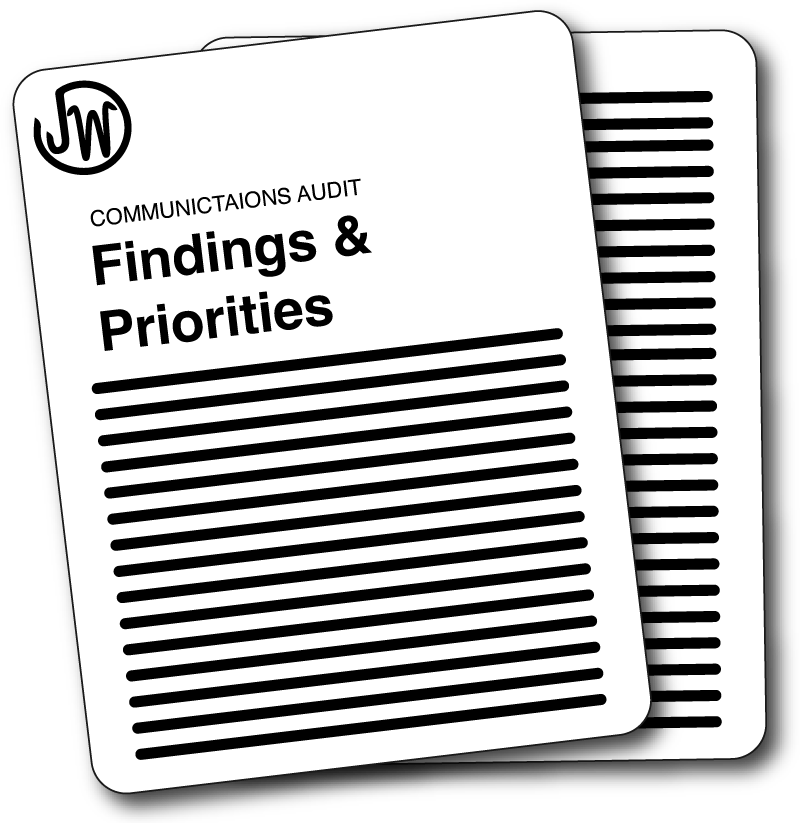
What you receive
Clear direction you can actually use.
- An initial conversation about your goals and concerns
- An independent review and appropriate research
- Prioritized findings and practical recommendations
- A live consultation and written summary
Two ways to work together
Focused Consultation
For a specific question. I review the relevant materials in advance, then we work through the problem in a live session.
Full Communications Audit
For a broader assessment. You receive research, written findings, prioritized recommendations, and a consultation.
A Straightforward Process
1
Define the questions
2
Review & research
3
Set clear priorities
4
Discuss what’s next
Useful on its own
The audit belongs to you.
Use the recommendations internally, share them with your team, or bring them to another designer or consultant.
If the audit points toward a website, strategy, or rebrand, it can also become the foundation for that work.
Let’s take an honest look at your communications.
Tell me what you would like reviewed and the questions you are trying to answer.
What is Covered?
Website Communications Audit
Your website often provides someone’s first substantial experience of your business or organization. A website communications audit looks beyond appearance to consider whether the site clearly explains who you are, what you offer, and what visitors should do next.
Depending on your website and the questions you want answered, the audit may examine:
- Message clarity: Can someone quickly understand who you are, what you do, and why it matters?
- Audience pathways: Can customers, clients, members, donors, or other audiences find the information meant for them?
- Navigation and organization: Is the content arranged in a way that makes sense to someone outside your organization?
- Calls to action: Are the most important next steps clear, specific, and easy to complete?
- Content: What is missing, outdated, repetitive, unclear, or unnecessarily long?
- Visual presentation: Does the design support your message and reflect the organization you are today?
- Mobile experience: Does the site remain understandable and usable on a phone?
- Accessibility: Are there obvious barriers that could make the site difficult to read, understand, or navigate?
- Credibility and trust: Does the website feel current, reliable, and attentive to the needs of its visitors?
- Ongoing maintenance: Is the website realistic for your staff and resources to keep current?
You receive a prioritized view of what should be addressed now, what can wait, and whether improving the current website or planning a new one makes the most sense.
Digital Communications Audit
Digital communications often develop one channel at a time. A website is redesigned, a social account is added, an email list grows, and eventually each piece begins operating independently.
A digital communications audit examines the full picture. Depending on the agreed scope, it may include:
- Website: The role your website plays as the central source of information about your work
- Social media audit: Which platforms you use, what you publish, who you reach, and whether the effort is producing meaningful engagement
- Email communications: Sign-up pathways, frequency, content, organization, and the relationship between email and your other channels
- Online listings: The accuracy and consistency of search results, business profiles, directories, and other public listings
- Message consistency: Whether people encounter the same essential identity and priorities across channels
- Visual consistency: Whether your communications feel recognizably connected without becoming rigid or repetitive
- Audience journeys: How someone moves from discovering you to learning more, making contact, attending, donating, purchasing, or taking another meaningful action
- Content priorities: What you need to communicate regularly and what may not deserve continued effort
- Workflows and capacity: Who is responsible for each channel and whether the current expectations are realistic
- Performance: Available analytics and engagement patterns that can help identify what is working
The result is a clearer digital communications strategy: which channels to prioritize, how they should support one another, what can be simplified, and what you may be able to stop doing.
Community Awareness Evaluation
Organizations often have a clear internal understanding of their identity and importance. That understanding does not always reach the surrounding community.
A community awareness evaluation begins with a straightforward question: What do people actually know about you?
Depending on the scope, the evaluation may include:
- Public presence: What someone can learn from your website, social media, printed materials, signage, and other communications
- Local search: What appears when someone searches for your name, your services, or organizations like yours
- Public descriptions: How your work is described in directories, media coverage, partner websites, event listings, and other outside sources
- Internal perspective: How staff, leadership, board members, or other stakeholders describe the organization and its role
- External perspective: What clients, members, neighbors, community partners, or members of the public understand about you
- Interviews or surveys: Structured research to identify recurring perceptions, questions, and misunderstandings
- Message gaps: Important parts of your identity or work that are not reaching the people you want to reach
- Community relevance: Whether your communications connect your work to the needs, interests, and concerns of the surrounding community
- Opportunities for outreach: Practical ways to strengthen recognition, understanding, and connection
This is not a formal evaluation of program outcomes. It focuses specifically on awareness, understanding, and public perception.
You receive a clearer picture of the gap between how you understand your organization and how others experience it—along with recommendations for closing that gap.
Ready for a clearer view?
Tell me what you’d like evaluated and the questions you’re trying to answer. I’ll help you determine the right scope, from a focused consultation to a full communications audit.